TWO:But should a man who is banished and excluded for ever from the society of which he was a member be also deprived of his property? Such a question may be regarded from different points of view. The loss of property is a greater punishment than banishment; there ought, therefore, to be some cases in which, according to his crime, a man should lose the whole, or part, or none of his property. The confiscation of the whole will occur, when the legal sentence of banishment is of a kind to annihilate all the ties that exist between society and its offending member; for in such a case the citizen dies, and only the man remains; and with regard to the political body civil death should produce the same effect as natural death. It would seem then that the confiscated property should pass to a man¡¯s lawful heirs rather than[182] to the head of the State, since death and banishment in its extreme form are the same with regard to the body politic. But it is not by this subtlety that I dare to disapprove of confiscations of property. If some have maintained that confiscations have acted as checks on acts of revenge and on the great power of individuals, it is from neglecting to consider that, however much good punishments may effect, they are not for that reason always just, because to be just they must be necessary; and an expedient injustice can be tolerated by no legislator, who wishes to close all doors against watchful tyranny, ever ready to hold out flattering hopes, by temporary advantages and by the prosperity of a few persons of celebrity, in disregard of future ruin and of the tears of numberless persons of obscurity. Confiscations place a price on the heads of the feeble, cause the innocent to suffer the punishment of the guilty, and make the commission of crimes a desperate necessity even for the innocent. What sadder sight can there be than that of a family dragged down to infamy and misery by the crimes of its head, unable to prevent them by the submission imposed on it by the laws, even supposing such prevention to have been within its power!There are three sources of the moral and political principles which govern mankind, namely, revelation, natural law, and social conventions. With regard to their principal object there is no comparison between the first and the other two, but they all resemble one another in this, that they all three conduce to the happiness of this present mortal life. To consider the different relations of social conventions is not to exclude those of revelation and natural law; rather it is the thousandfold changes which revelation and natural law, divine and immutable though they be, have undergone in the depraved mind of man, by his own fault, owing to false religions and arbitrary notions of virtue and vice, that make it appear necessary to examine, apart from all other considerations, the result of purely human conventions, expressed or implied, for the public need and welfare: this being an idea in which every sect and every moral system must necessarily agree; and it will always be a laudable endeavour, which seeks to constrain the headstrong and unbelieving to conform to the principles that induce men to live together in society. There are, then, three distinct kinds of virtue and vice¡ªthe religious, the natural, and the political. These three kinds ought never to conflict, although all the consequences and duties that flow from any one of them do not necessarily flow from the others. The natural law does not require all that revelation requires,[114] nor does the purely social law require all that natural law requires; but it is most important to distinguish the consequences of the conventional law¡ªthat is, of the express or tacit agreements among men¡ªfrom the consequences of the natural law or of revelation, because therein lies the limit of that power, which can rightly be exercised between man and man without a special mandate from the Supreme Being. Consequently the idea of political virtue may, without any slur upon it, be said to be variable; that of natural virtue would be always clear and manifest, were it not obscured by the stupidity or the passions of men; whilst the idea of religious virtue remains ever one and the same, because revealed directly from God and by Him preserved.
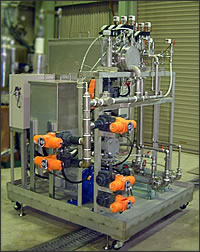
A hydrocyclone (liquid cyclone) injects treatment solution into stationary equipment to perform separation, classification, and concentration, and is an innovative separator with a very simple structure and no drive unit.
Structure of a hydrocyclone (liquid cyclone)
A suspension containing fine particles of several micrometers or more is supplied to a cylindrical container circumferentially at high speed. And as a result it starts to rotate and a centrifugal force is generated. At this time a gravitational acceleration of several tens of thousands of G is generated in the circumferential direction, and thus leading to fast sedimentation and concentration of the fine particles. The separated concentration can be freely selected by changing the supply rate (supply pressure and flow rate) and the flow ratio of the outlet. Our hydrocyclone (liquid cyclone) was designed and manufactured to classify and concentrate fine particles, and so has a small element.
THREE:
- Equipment costs can be reduced.
- Operating costs can be reduced.
- Maintenance costs can be reduced.
- Any change in raw material and product can be easily addressed.
- Large amounts can be treated in a small area.
- Separation and cleaning are easy because of the simple structure.
- Simplified control
- This equipment can be operated in synchronization with external devices.
- Alarm and interlock mechanism.
THREE:There are three sources of the moral and political principles which govern mankind, namely, revelation, natural law, and social conventions. With regard to their principal object there is no comparison between the first and the other two, but they all resemble one another in this, that they all three conduce to the happiness of this present mortal life. To consider the different relations of social conventions is not to exclude those of revelation and natural law; rather it is the thousandfold changes which revelation and natural law, divine and immutable though they be, have undergone in the depraved mind of man, by his own fault, owing to false religions and arbitrary notions of virtue and vice, that make it appear necessary to examine, apart from all other considerations, the result of purely human conventions, expressed or implied, for the public need and welfare: this being an idea in which every sect and every moral system must necessarily agree; and it will always be a laudable endeavour, which seeks to constrain the headstrong and unbelieving to conform to the principles that induce men to live together in society. There are, then, three distinct kinds of virtue and vice¡ªthe religious, the natural, and the political. These three kinds ought never to conflict, although all the consequences and duties that flow from any one of them do not necessarily flow from the others. The natural law does not require all that revelation requires,[114] nor does the purely social law require all that natural law requires; but it is most important to distinguish the consequences of the conventional law¡ªthat is, of the express or tacit agreements among men¡ªfrom the consequences of the natural law or of revelation, because therein lies the limit of that power, which can rightly be exercised between man and man without a special mandate from the Supreme Being. Consequently the idea of political virtue may, without any slur upon it, be said to be variable; that of natural virtue would be always clear and manifest, were it not obscured by the stupidity or the passions of men; whilst the idea of religious virtue remains ever one and the same, because revealed directly from God and by Him preserved.
- Classification and concentration for the manufacture of inorganic powder materials
- Classification of ceramic materials
- Removal of fine particles, including iron powder
- Removal of fine particles from pigments
- Removal of fine organic particles from solvents
- Separation of starch and yeast
- Removal of fine particles from high-temperature strong acid solutions
- Removal of fine particles from low-temperature solutions